


Video transcript:
If you’re investing in SEO services or Google Ads and your pages are too generic, then your traffic just isn’t going to convert. The more specific your page and your messaging is, then the more likely they are to take the action, ideally a conversion, on your landing page .
So I want to walk you through an example of one of our clients, Premier Education, and how we’ve addressed this with them.
Premier Education are a tutoring provider based in Melbourne, helping students with maths and English, and more. The challenge they were facing was visibility. So parents couldn’t easily find the tutoring services that they were looking for, and the website wasn’t generating enough inquiries to support the company’s growth goals.
Here are the things that we did with the Premier Education team to help.
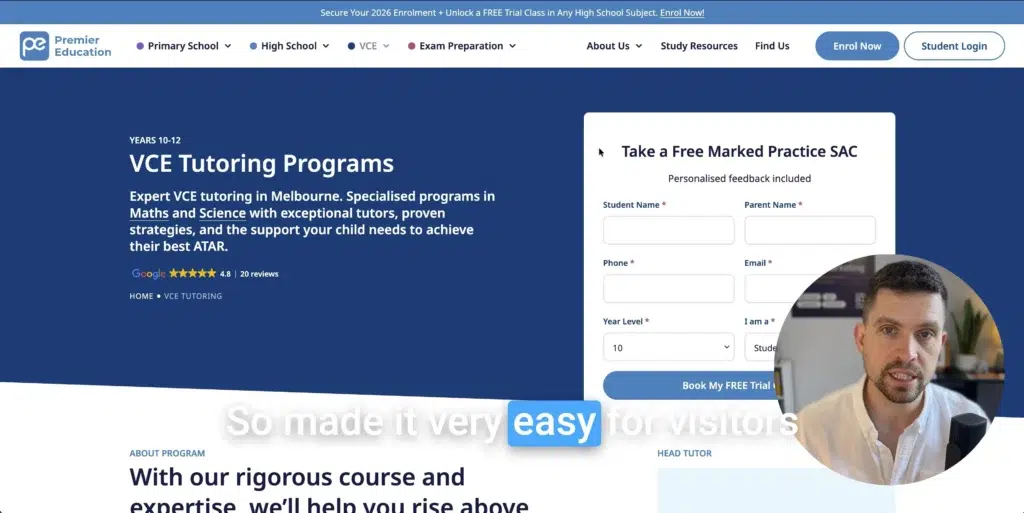
If I go into the VCE tutoring programs, we have a very specific landing page, specific messaging, links to subpages. We’ve got a call to action with an offer, so a lead generation form here, and trust signals. All of this before anyone has scrolled.
The relevancy score is very high. We improved the conversion optimisation as well. So made it very easy for visitors to know what the next step is. Rather than something generic like contact us or get in touch, there is a clear and high perceived value next step. We’ve got here, book my free trial class, and a very simple form to collect only the most essential information.
A big mistake we see is people have really long fields because their sales team want to know all these different things, and that typically reduces conversions. If you’re not getting enough conversions, keep your forms very simple. If you’re getting low quality conversions but high volume, then you can start to introduce some constraints into your forms.
The next thing we helped Premier Education with is something called topical authority, which is about creating useful content for their target audience to show that they are an expert on a particular topic and to add value.
Within their study resources, which is what a lot of businesses call a blog, within each one of these blog posts, there’s headings, there’s value, there’s images. I’ll click through to one of these. You can see how quickly the page loads as well. So really clear heading. It provides value to their target audience, and it’s related to the services that they offer.
So this is something that can be used to attract and convert their target audience and be part of onboarding, so it’s fantastic high leverage asset. So there’s a relevant image, nice clear formatting for the blog post, different styles between headings and bullets and bold, and then the addition of images.
So with AI making it super simple to create content, unfortunately for everyone it’s very simple to create content. So using images helps to differentiate, it helps to give more media to the page to make it more rich, which will improve your rankings and relevance. The overall goal here isn’t to trick AI or trick the SEO systems, but to provide real value for your audience, and that’s what these kind of blog posts are all about.
Now scrolling down to the bottom, there’s also FAQs, which is super helpful when it comes to your target audience, but also for the AI answers, and then a clear next step. So book a free consultation or enroll now. So it’s taking from the content and moving towards conversion, so providing value from marketing and moving towards sale.
With these foundations of landing pages and then consistent blogging in place, we also introduced Google Ads to help amplify their results.
By driving traffic with both Google Ads and SEO, it means that they’re able to generate leads now through their ads and then have an ongoing trust-building consistent system through SEO so they’re not dependent on ads forever.
This creates a multi-channel lead generation system rather than relying on a single source of traffic.
We also set up a lead tracking and channel attribution system called SGD Lead Flow, so they can see which channel is generating leads.
This is built right into their website platform, so they can easily log in and they can see lead over time across multiple website forms, what is the value of the specific leads, and what is the value of the specific channel.
We can see here organic search driving the majority of their lead flow, followed by direct traffic and then paid search, paid social. So they can see the return on investment that they’re getting through each one of these channels.
The results over the last 12 months have been pretty amazing considering the impact of AI is having on website traffic. They’ve been able to increase the total users, and this is just through the channel organic search, total users on the website by over 100%, so more than doubled. New users 110%, so even more than doubled there.
Impressions, you can see that is consistently growing as well. So that’s over six times what it was this time last year. And then conversions, over 37% increase on last year.
The big lesson here is this isn’t about SEO or Google Ads. It’s a combination of things.
When you align what people are searching for, so the keywords that are active, the search volume, and the intent behind those things, when you align that with the page, the specific page that they’re looking at, so the relevance is really high, and you’ve got a compelling offer, so you’re very, very clear with the action that you want them to take and reduce the friction so they can take that action easily, then your marketing becomes significantly more effective.
So looking at your own business now, if someone landed on your website, would they immediately find the service that they’re after? Is the next step clear? Is the heading really clear?
Make adjustments to this and you’ll improve your conversions and people will find you in the search and AI engines.