


Most SEO campaigns fail because they try to do everything at once. Keyword themes are how we fix that.
If you’ve ever worked with an SEO agency and felt like the strategy was vague, scattered, or hard to follow, you’re not alone. A lot of SEO providers take a broad approach; they’ll run a technical audit, make some changes across your website, and hope for the best. There’s no real focus. No clear priority. And often, no meaningful results to show for it.
At SGD, we take an approach to SEO that’s focused, systems-driven, and that gets results. The foundation of every SEO campaign we run is built around keyword themes. It’s a simple concept, but it’s one of the main reasons our clients see consistent, measurable improvements in their search rankings and leads.
So What Exactly Is a Keyword Theme?
A keyword theme is a focused group of related search terms tied to one specific service you offer, in one specific location, targeting one dedicated landing page on your website.
That’s the formula: service + location + landing page = one keyword theme.

That intent piece matters. Someone searching for “linen” is usually looking for general information, ideas, or broad options. Someone searching for “wholesale linen supplier Sydney” is showing a much stronger intent to buy. Those are two very different searches, and they need two very different SEO approaches.
For example, if you’re a commercial linen supplier based in Sydney, “commercial linen Sydney” would form the basis of a keyword theme. Within that theme, you’d have a primary focus keyword, the one with the strongest combination of search volume, commercial intent, and relevance to your business, plus a handful of secondary keywords that are closely related variations. Think “commercial linen supplier,” “wholesale commercial linen,” or “commercial linen company.”
Each of those secondary keywords supports the primary one. They give Google more signals about what your page is about, and they capture people searching for the same thing in slightly different ways. Instead of chasing one keyword with a search volume of 70 per month, you’re capturing an entire cluster that might add up to 800+ monthly searches, all pointing to the same page.
Why Not Just Target 50 Keywords Across the Whole Site?
One of the biggest mistakes most SEO campaigns make is trying to do too much at once.
It’s like going to the gym and doing one rep of every exercise in the room. You’re moving, but you’re not giving any one muscle group enough attention to create real progress. You’re much better off focusing on specific muscle groups and doing multiple reps and sets over time. That’s what creates meaningful change. The same is true for your SEO campaign. A focused approach is what creates results.
SEO is no different from anything else that requires consistency and focus. If you try to optimise for everything at the same time, you end up diluting your efforts. The old approach to SEO was to pick 20 or 30 keywords, scatter them across the site, and hope something sticks.
The problem is that without a clear structure, without knowing which page targets which keywords, and which service takes priority, you end up with a website that’s a little bit relevant for a lot of things, but not strongly relevant for anything.
Google rewards focus. A dedicated landing page that’s clearly about one service, in one location, with supporting content and consistent activity around that topic, will outperform a generic page trying to cover five different services every time.
How We Structure Keyword Themes for Our Clients
When we take on an SEO client, we identify five keyword themes based on the primary services they offer, ranked by which ones are most likely to generate revenue. We research and track all five, but we actively optimise for two or three at a time, depending on the client’s plan.
Why track five if we’re only working on two or three? Because it gives us a clear picture of where the opportunities are. We can show a client how their other services are performing in search, even before we start working on them. Once we’ve built momentum with the first themes, there is already a roadmap for what comes next.
Within each theme, we usually work with around 10 – 12 keywords. There’s the focus keyword at the top, the one we’re aiming to move into the top positions in Google, and then there are secondary keywords that reinforce it. Some of those secondary keywords become headings on the landing page. Others become FAQ sections. Some become the basis for supporting blog content that links back to the main page.
Just as importantly, we check the intent behind each keyword before deciding where it fits. If a keyword suggests the person is ready to enquire, compare providers, or buy, that’s a strong candidate for the core landing page. If the search is more educational, it may be better suited to a supporting blog article that helps build authority and guides the user toward the main service page.

This isn’t just an SEO principle, it’s a user experience principle, too. When someone searches for “high school tutoring Melbourne” and lands on a page with that exact headline, their brain immediately registers that they’re in the right place. If they land on a generic “our services” page that mentions tutoring alongside ten other things, they’re far more likely to bounce.
Google works the same way. It wants to serve the most relevant result for any given search. A page that’s laser-focused on one topic will always have an advantage over a page that’s spread thin.
Real Results From Real Focus
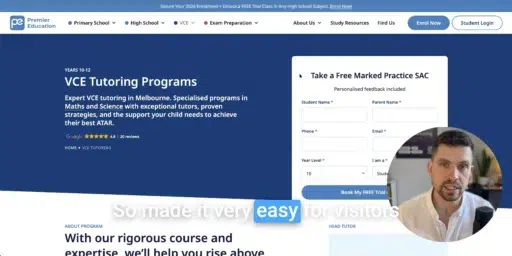
One of our education clients is a great example of this in action. We started with two keyword themes: VCE maths tutoring and VCE tutoring more broadly. After consistent work over several months, both themes were performing strongly with solid rankings and genuine leads coming through.
Because we’d already been tracking a third theme, high school tutoring, we had the data ready to go. The client could see the opportunity, trusted the process based on the results we’d already delivered, and gave us the green light to activate it. We’re now refining the keywords for that theme, planning a new dedicated landing page, and we’re confident it’ll be generating results within a couple of months.
That’s the value of the theme-based approach. It’s not reactive or random. It’s a structured system where each win helps set up the next one.
How Supporting Content Fits In
A landing page on its own is strong, but it gets stronger with the right supporting content around it. This is where blogs, FAQs, and internal linking come into play.
If we notice a secondary keyword has decent search volume, but the landing page alone isn’t enough to rank for it, we’ll create a blog post targeting that specific term and link it back to the main landing page. That blog helps show Google that your site has depth and authority on that topic. In some cases, we also feature relevant blog posts directly on the landing page to create a stronger content hub around the theme.
FAQs are another tool we use within themes. If there’s a lower-volume keyword that’s still relevant, something people genuinely ask about, adding it as an FAQ on the landing page can sometimes be enough to start ranking for it without needing a separate page. For keywords with a search volume of 20 or 30, that’s often all it takes.
The important point is that every piece of content has a job to do. It supports a specific theme. It links to a specific landing page. Nothing is created without a clear reason.
Intent Matters as Much as Volume
Not all keywords are created equal. A keyword might have high search volume, but if the people searching for it aren’t looking to buy, it’s not going to generate leads for your business.
We always check what Google actually shows for a keyword before we commit to targeting it. If the search results are full of informational articles and Wikipedia entries, that tells us people are researching, not buying. But if we see competitor businesses, product listings, and ads, that’s a commercial keyword, and that’s where we want to be.
A keyword like “commercial linen” may still be too broad depending on the results. That’s a good sign. But something like “wholesale linen supplier Sydney” gives a much clearer signal that the searcher is looking for a provider. That kind of intent is what makes a keyword useful as the focus of a revenue-driven SEO campaign.
Both informational and commercial searches have a place in SEO. The key is knowing which one belongs on the landing page and which one belongs in a supporting content piece.
Consistency of Activity
The final piece of the puzzle is consistency. SEO is not a one-off task. Google favours websites that are actively maintained, regularly updated, and consistently publishing relevant content. A site that improves steadily over time will usually outperform one that does everything in a single burst and then goes quiet.
This is why our campaigns are built around ongoing monthly work rather than one-off projects. Each month, we’re creating content, building links, monitoring rankings, and making adjustments based on what the data tells us. That ongoing activity is part of what helps build visibility over time.
The Bottom Line
Keyword themes aren’t complicated. They’re a focused, structured approach to SEO that ensures every action we take has a clear purpose and ties back to a specific business goal. One service, one location, one landing page, supported by targeted content and consistent effort.
It’s the difference between hoping your website ranks and building a system that’s designed to make it happen.
SGD is a Melbourne-based digital agency specialising in SEO, Google Ads, and website design for service-based businesses across Australia. If you’d like to find out how a keyword theme strategy could work for your business, get in touch for an SEO assessment.