


In 2026, ChatGPT now receives more than 2.5 billion prompts every day. That alone tells us one thing clearly: AI is already part of the customer buying journey.
If your website is not optimised to be understood, trusted, and referenced by AI tools, you risk becoming invisible as AI-driven search continues to grow.
AI systems do not browse the web like humans. Crawling and retrieving content is expensive for them (not to mention the water usage).
The easier your website is to crawl, interpret, and trust, the more likely your business is to be surfaced, quoted, and recommended.
The good news is this: the fundamentals of SEO still apply for GEO (Generative Engine Optimisation).
What’s changed is where and how that work pays off to get businesses visible and found at the right point of the customer journey.
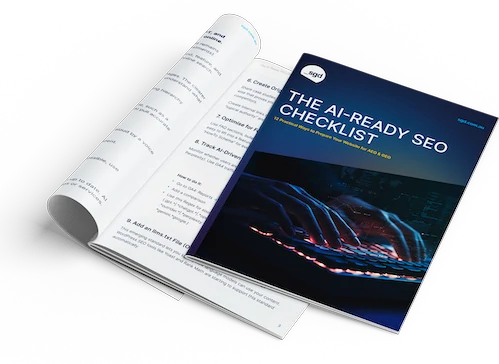
Below are the practical website foundations we’re seeing matter most for AI visibility.
1. Conversion-driven design matters
AI visibility is not useful if your website does not convert. Your site needs to make it instantly clear:
- What you do
- Who you do it for
- How someone takes the next step
Clear messaging, strong calls to action, and proven landing page structures matter more than ever. AI can send attention your way, but your website still has to do the job of turning that attention into enquiries.
If your pages are unclear or unfocused, AI visibility will not translate into revenue.
Related: How To Optimise A Landing Page For Higher Conversions
2. Fast-loading websites win
Slow websites are bad for users and more expensive for AI crawlers to process.
If you’re using WordPress, keep things simple:
- Use a lightweight theme
- Avoid unnecessary plugins
- Keep your site easy to maintain
A practical starting point is to test your site with GTmetrix, then pass that report to your web developer to fix the biggest issues first. Speed improvements benefit users, SEO, and AI visibility at the same time.
3. Your sitemap defines structure
Your sitemap is not just a technical file. It’s a map that tells search engines and AI what topics you are (and are not) an authority on.
AI uses this structure to understand:
- Your services
- The locations you serve
- Your areas of expertise (“topical authority” in SEO terms)
Make sure you have dedicated pages for each core service and each relevant location. For example, separate pages for “cleaning services in Canberra”, “end of lease cleaning in Canberra”, and so on.
A standard XML sitemap is enough for now. You may hear about llms.txt files, but they are not yet an industry standard. Focus on getting the basics right first.
4. Internal linking gives AI context
Internal links connect related content across your website.
They help AI and search engines understand how topics relate to each other and which pages matter most.
As a simple rule, all supporting content should link back to the primary service page it relates to. If you run a cleaning business, your blogs and guides should consistently link back to your main cleaning services page.
This reinforces topical authority and improves both rankings and AI visibility.
5. Keep your About page accurate and specific
AI crawlers use your About page to learn who you are.
Make sure it is current, factual, and explicit about what makes your business credible.
Recently, we updated our own About page to clearly state that we are an “award-winning digital agency”. While we had mentioned awards in blog posts before, we had never stated this clearly on the About page.
Within days, AI-generated results started describing Seriously Good Design as an award-winning digital agency. That change happened because we wrote it clearly, accurately, and backed it with evidence.
If you want AI to say something about your business, you often need to say it first.
6. Regular blogging builds visibility and trust
If your website is not being seen, it is often because it is not being updated.
Blogging is one of the simplest ways to stay visible. More importantly, it allows you to help your audience before they buy from you.
When you can reference a helpful article during a sales conversation, it builds trust and positions your business as a guide, not just a vendor.
Consistent, useful content remains one of the strongest signals for both search engines and AI tools.
7. Keep directory listings accurate
Directory listings are another trust signal AI looks at.
If your business name, address, or phone number is inconsistent or outdated across the web, it creates doubt. Accuracy and consistency matter.
Make sure your NAP details match everywhere they appear.
Related: Top Australian Directories for SEO in 2026
8. Use the right schema
Schema is the structured data that tells search engines and AI what type of content is on each page.
This includes schema for:
- Organisations
- Services
- FAQs
- Articles
- Reviews
Ask your SEO team or web developer to review your schema and ensure it is correctly implemented and automated for future pages. (If you don’t have a team yet, our managed SEO services handle this and the rest of the AI-readiness work above.)
9. Add FAQs within your content
FAQs are one of the simplest and most effective ways to capture AI-driven queries.
By answering common questions directly on your service pages and blog posts, you increase your chances of appearing in AI results and voice searches.
This approach helps AI match natural language questions with your content and positions your website as a helpful, reliable source.
By improving these foundations, you put your business in a strong position to be seen, trusted, and selected as AI-driven search continues to evolve.
Need help optimising your website for AI search?
Book a call with our head of strategy, Simon Kelly, to review your current performance put together a game plan for your business.