How To Optimise A Landing Page For Higher Conversions


If you’re investing in digital marketing but not seeing the returns you want, then it’s likely that your landing pages are the problem – not your traffic.
Many businesses assume that increasing traffic will automatically lead to more conversions.
But if your landing page isn’t built to convert, you’re simply sending more visitors to a page that isn’t doing its job.
Before driving more traffic, start by focusing on converting the visitors you already have. A few small changes on your landing page can make a big difference that can significantly impact your conversion rates.
In this article, we’ll look at best practices for landing pages so you can get the most from your website traffic.
Key takeaways:
- Fix landing pages before adding more traffic
- Win the first 5 seconds: invest ~80% in the hero section
- Prove credibility fast: logos, reviews, case studies with numbers, and certifications
- Make action easy: one primary CTA, a secondary option, short forms and clear next steps
- Design and iterate: premium design, fast loading, mobile layout, match message to intent
What Makes a High-Converting Landing Page?
A high-converting landing page is one that converts visitors into leads higher than other pages on your website.
When your website is turning visitors into leads and revenue, this is called a conversion rate. When you improve your conversion rate of your landing pages, you increase the value of any and all traffic that’s sent to your website.
That’s why effective website landing pages is one of the most valuable marketing assets your business can have.

Landing Page Examples
Here are a few landing page examples that demonstrate the principles from this article and best practices for conversions.
CyberCX landing page
A clear heading, call to action, benefits, FAQs, and trust signals increased conversions from 4% to 20%. View CyberCX.

AS Freight landing page
A clear call to action in the header, Google reviews, and a simple form drives conversions each week from their SEO and Google Ads campaigns. View AS Freight.

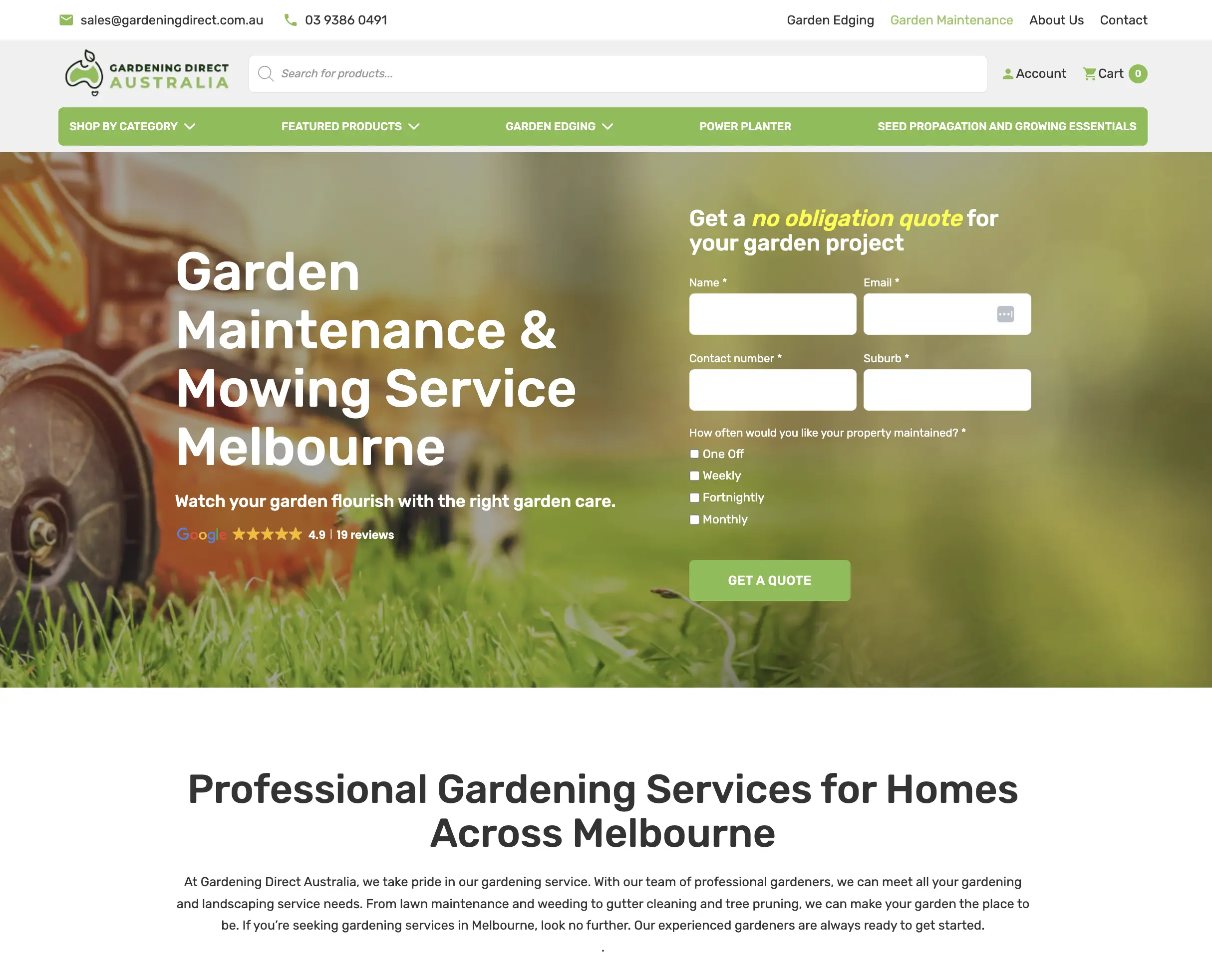
Gardening Direct landing page
A form in the header, a title that matches their ads and clear trust signals drives conversions from their Google Ads campaigns. View Gardening Direct.
The Owl IT landing page
Adding trust signals and a form to the header of their key services generated the first online conversions they have had in years. View The Owl.

Landing Page Checklist
To help you create landing pages that convert, we’ve put together this simple checklist based on time-tested best practices.
Use this checklist to assess your landing pages to make sure you’re making the most of every opportunity.
1. Clear, Attention-Grabbing Headline
A weak or unclear headline is one of the biggest reasons visitors leave a landing page. Your headline is the first thing people see—make it count.
It should instantly address your audience’s pain points or desires in a way that is clear, concise, and compelling.
It’s important to be clear before you try to be clever.
As Donald Miller, author of StoryBrand, says: “If you confuse them, you’ll lose them.”
Test different headlines to see what resonates most with your audience—it’s one of the most powerful elements of your landing page.
2. Subheading & Visuals
Your subheading should reinforce the benefit of your offer and make it even more compelling.
This is your chance to increase desire and make it clear who your offer is for and who it’s not for.
If you haven’t already, mention your target audience and value proposition here.
Pair this with a photo or video that visually demonstrates your offer in action.
A great image or video can instantly clarify your message and help visitors see themselves using your product or service.
3. Trust Signals & Social Proof
Nobody wants to be the first to take a risk on a business they don’t know anything about.
Before making a decision, potential customers look for proof that others have had a great experience.
Social proof reduces hesitation, builds trust and reassures visitors that they’re making the right choice.
This works just as well for B2B as it does for B2C markets.
Here’s how to build trust on your landing page:
- Include logos of well-known businesses you’ve worked with – If reputable companies trust you, new customers will feel more confident doing the same.
- Case study results & testimonials – Showcase real results and success stories. Specific numbers and details make testimonials even more persuasive.
- Google reviews & industry certifications – Third-party validation adds instant credibility. The more positive reviews and recognised certifications you display, the stronger the trust factor.
A strong landing page doesn’t just tell people you’re great—it proves it through the words of your happy clients and industry recognition.
4. A Clear Call to Action (CTA)
If visitors don’t know what to do next, they won’t take action.
Make it painfully obvious what their next step should be.
- Keep it simple and action-driven. Whether it’s booking a call, requesting a quote, or signing up, your CTA should be crystal clear and easy to find.
- Make it visible. Use bold buttons with high contrast and place them above the fold (visible without scrolling).
- Give them options. Not everyone is ready to buy right away. Include both a primary and secondary call to action (CTA).
- Primary CTA: A direct action like “Get a Free Consultation” or “Request a Quote.”
- Secondary CTA: A low-commitment option like “Download the Guide” or “Watch a Demo.”
A strong CTA removes friction and makes the decision easy.
The fewer barriers, the more conversions.
Pro tip:
In our Google Ads and SEO campaigns, we’ve found that secondary CTAs often convert at a high rate with a lower cost per acquisition.
This is because they offer something valuable in exchange, rather than pushing for an immediate sale.
5. Landing Page Design Matters
Your landing page sets the first impression of your business—make it count.
If your page looks outdated or unpolished, your audience may assume the same about your entire business.
On the other hand, if you’re offering a premium service, your design should reflect that level of quality.
A well-designed page builds trust, enhances credibility, and makes visitors more likely to take action.
Next Steps
To make the most from these tips, you need to put them into action. Here’s how to get better results from your landing pages:
- Choose your most profitable service to focus on
- Assess your landing page against these best practices
- Make one change and track the results
Need help? Talk to our web design team to build landing pages that convert.